
Microchip MCP6052T-E/SN Dual Op-Amp: Features and Application Circuit Design
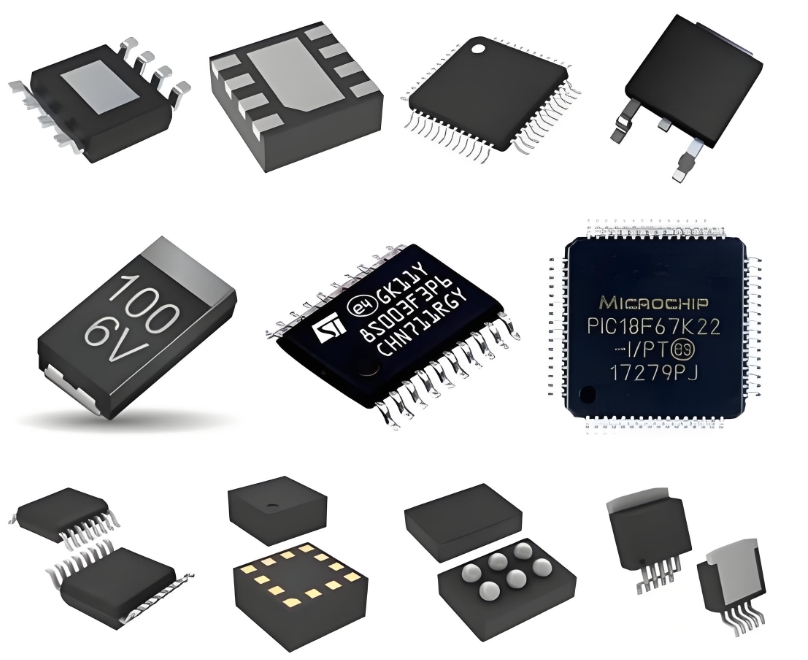
The MCP6052T-E/SN from Microchip Technology is a dual operational amplifier that stands out for its exceptional combination of performance, low power consumption, and small form factor. Housed in a compact 8-pin SOIC package, this op-amp is engineered for a wide range of portable and battery-powered applications where efficiency and space are critical design constraints. Its key specifications make it an ideal choice for sensor interfaces, active filters, and signal conditioning blocks.
Key Features and Specifications
The defining characteristics of the MCP6052 are centered on its precision and efficiency:
Low Power Consumption: The device operates with a quiescent current of just 20 µA per amplifier, making it perfect for applications that demand extended battery life.
Rail-to-Rail Input/Output (RRIO): This feature allows the input and output signals to swing very close to both power supply rails (VDD and VSS), maximizing the dynamic range in low-voltage systems.
Low Offset Voltage: With a typical input offset voltage of 500 µV, the amplifier provides high accuracy for DC signal amplification, which is crucial for precision instrumentation.
Gain Bandwidth Product: The 50 kHz gain bandwidth product is well-suited for processing audio frequencies, biomedical signals, and other low-frequency analog data.
Wide Supply Voltage Range: It can operate from a supply voltage as low as 2.3V up to 5.5V, supporting both 3.3V and 5V microcontroller-based systems.
Application Circuit Design: A Precision Photodiode Amplifier
A common and critical application for a precision op-amp like the MCP6052 is a transimpedance amplifier (TIA) for photodiodes. This circuit converts the small output current from a photodiode into a measurable voltage.
Circuit Operation:
One half of the MCP6052 is configured as a TIA. The photodiode is connected between the op-amp's inverting input and ground. A feedback resistor (R_F) is connected from the output back to the inverting input. The non-inverting input is biased at a reference voltage, often ground (0V) for photoconductive mode operation.
When light hits the photodiode, it generates a small current (I_PD). Since the inverting input is a virtual ground, this current flows entirely through the feedback resistor R_F. The output voltage (V_OUT) is therefore given by:
V_OUT = -I_PD × R_F
This simple equation shows that the output voltage is directly proportional to the photodiode current. The choice of R_F determines the circuit's sensitivity; a larger value provides more gain but may reduce bandwidth and increase noise.
Design Considerations:
1. Stability: The parasitic capacitance of the photodiode (C_PD) can create a pole in the feedback loop, leading to oscillation. A small feedback capacitor (C_F) in parallel with R_F is essential to compensate for this, forming a low-pass filter and ensuring a stable output. The cutoff frequency is f_c = 1 / (2π × R_F × C_F).
2. Power Supply Bypassing: For optimal performance, it is crucial to place a 0.1 µF decoupling capacitor close to the op-amp's power supply pins to minimize noise and prevent instability.
3. PCB Layout: Keep the connections to the inverting input as short as possible to minimize stray capacitance. Guard rings can be used to reduce leakage currents in high-impedance applications.
ICGOODFIND: The MCP6052T-E/SN proves to be an exceptionally versatile component for designers. Its ultra-low power consumption and rail-to-rail operation unlock high-performance analog design in space-constrained, battery-powered systems. The precision transimpedance amplifier circuit exemplifies its capability to accurately measure weak signals, solidifying its role as a reliable solution for portable instrumentation, medical devices, and advanced sensor modules.
Keywords:
1. Low Power Consumption
2. Rail-to-Rail Input/Output (RRIO)
3. Transimpedance Amplifier (TIA)
4. Signal Conditioning
5. Photodiode Amplifier

